
Trigg County Arrest Records and Court Charges
Trigg County arrest records begin with an arrest by the Trigg County Sheriff's Office, Cadiz Police Department, Kentucky State Police, or another agency. The local custody fact is important: Trigg County has a county jailer, but people arrested in Trigg are transported to Christian County Jail after arrest. That means the booking side may appear through the Christian County Jail inmate list, while the legal charge side is tracked through Kentucky trial-court records.
A charge record is narrower than a full criminal file. It focuses on the offense named by citation, complaint, warrant, information, or indictment; the statute or charge text; the level of offense; the arresting or citing agency; bond; and early hearing dates. The complete case file, including pleas, motions, sentencing, and final disposition, belongs with Trigg County criminal court records. The jail roster and booking details belong with Trigg County inmate records.
This split prevents a common mistake. A booking entry can show a person was received at jail, but it may not show what the prosecutor later filed or whether the court amended the count. A court charge entry can show the legal accusation, but it may not prove where the person is housed now. For Trigg County, reliable review usually means checking both paths and then confirming uncertain facts with the clerk, jail, or jailer.
The Christian County Jail homepage is one official custody source for Trigg arrestees after transport.
That custody connection explains why a Trigg arrest can have one trail in jail records and another trail in the court charge record.
Trigg County Charges After Arrest
Charges after a Trigg arrest usually start in District Court when the matter is a misdemeanor, violation, traffic offense, ordinance case, or felony preliminary matter. Felony prosecutions can later move into Circuit Court after probable cause, indictment, or information. The Kentucky Court of Justice describes District Court as the court for misdemeanors, violations, traffic, ordinances, and felony preliminary stages, while Circuit Court handles felony criminal cases and broader trial work.
One arrest can produce several separate charges. A traffic stop, for example, can lead to citations, drug charges, firearm allegations, or warrants if the officer or prosecutor has grounds to proceed. A July 2025 WNKY report about a Trigg County Sheriff's Office traffic stop shows how a single law-enforcement event can become multiple filed criminal charges. News reports are not the court record, but they help show why charge lookup should focus on the court case after booking.
The WNKY traffic-stop report gives local context for how law-enforcement activity can become charge records.
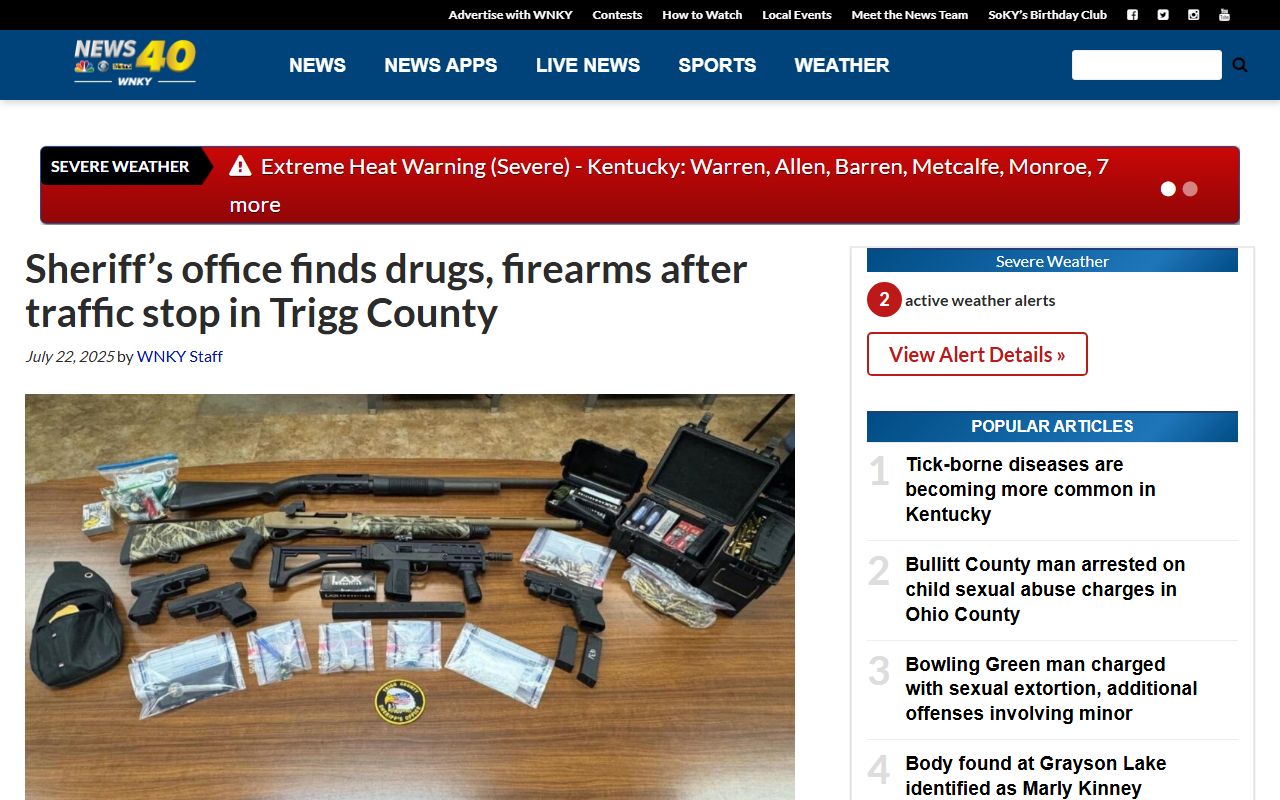
For record use, the key step is still to confirm the charge in KYeCourts or through the Circuit Court Clerk rather than rely on a news summary.
Search Trigg County Charge Records
The main court path is KYeCourts guest access, with help from the KCOJ search-options page. Public users may search by party, case number, citation, or business where the portal supports that mode. If the online result is incomplete, call the Office of Circuit Court Clerk at the Justice Center. Use Circuit Court at 270-522-6270 for felony or circuit-level questions and District Court at 270-522-7070 for misdemeanor, violation, traffic, ordinance, and felony preliminary matters.
- Search by defendant name, case number, citation number, or business name in KYeCourts when enough information is known.
- Check whether the case is in District Court or Circuit Court, because a felony may start in District Court and later continue in Circuit Court.
- Read the charge text, charge status, court dates, bond events, and disposition fields with care.
- Use the Christian County Jail list for current custody, then match any booking information to the court case.
- Call the Circuit Court Clerk if the case may be archived, sealed, transferred, or too old for online lookup.
The Christian County Jail inmate listing page links to the current custody roster used for Trigg arrestees after transport.
A roster match can support a custody check, but the filed charge and legal status should be verified through court channels.
Trigg County Charging Documents
The charge record begins with a charging document or citation. Kentucky records may use complaint, citation, information, indictment, or warrant language depending on the case type and stage. A citation can begin many traffic, violation, and misdemeanor matters. A felony may begin with a complaint and preliminary hearing in District Court, then proceed by indictment or information in Circuit Court.
| Document | Typical Role | Where It Matters | Record Clue |
|---|---|---|---|
| Complaint or citation | Starts many lower-level charges and felony preliminary matters. | District Court | May show officer, agency, charge text, citation number, and first court date. |
| Information | Prosecutor-filed charging paper used in some criminal matters. | Often Circuit Court for felony prosecution | Shows the charge selected by the prosecutor and court filing date. |
| Indictment | Grand-jury charging paper for felony prosecution. | Circuit Court | May replace or follow the initial District Court charge path. |
| Warrant | Court order tied to arrest, failure to appear, or other required custody action. | District or Circuit Court | May appear as a docket event, bond event, or served/recalled entry. |
Trigg County Charge Status
Charge status can change several times. A pending charge means the accusation has not reached final outcome. A charge may be amended if the prosecutor changes the offense, reduced as part of a plea, dismissed by the court, or disposed by plea, trial, diversion, or another authorized result. A public search result may show only a short status, so docket entries and clerk copies may be needed for the full sequence.
Felony status can be more complex because a District Court preliminary record may exist before the Circuit Court case opens. A dismissed preliminary count does not always tell the whole story if an indictment later begins a new Circuit Court case. The safest reading follows the case number, court division, charge text, and disposition together.
| Status | Plain Meaning | Why It Matters |
|---|---|---|
| Pending or active | The charge is still open. | Future hearings, bond terms, and warrants may still matter. |
| Amended or reduced | The filed accusation changed from an earlier charge. | The original arrest charge may differ from the final court charge. |
| Dismissed | The charge was ended without conviction on that count. | The reason and whether it was with or without prejudice may require the case file. |
| Transferred | The case moved from one court stage to another. | Felony matters can move from District Court preliminary stages to Circuit Court. |
| Disposed | The charge reached an outcome. | Disposition must be read separately from arrest and booking data. |
Note: A stale jail roster entry or older docket line should not be treated as the current charge outcome without clerk or portal confirmation.
Bond After Trigg County Arrest
Bond information may appear in both jail and court channels. Christian County Jail publishes bond-posting details for people held there, including the Christian County Justice Center location for weekday posting, the after-hours rule that only cash bonds may be posted at the jail side entrance, and the need for valid photo identification. Court records may show bond type, bond amount, release conditions, forfeiture, or a later warrant if the person fails to appear.
The Christian County Jail bond information page is the relevant jail-side source for many Trigg detainees.
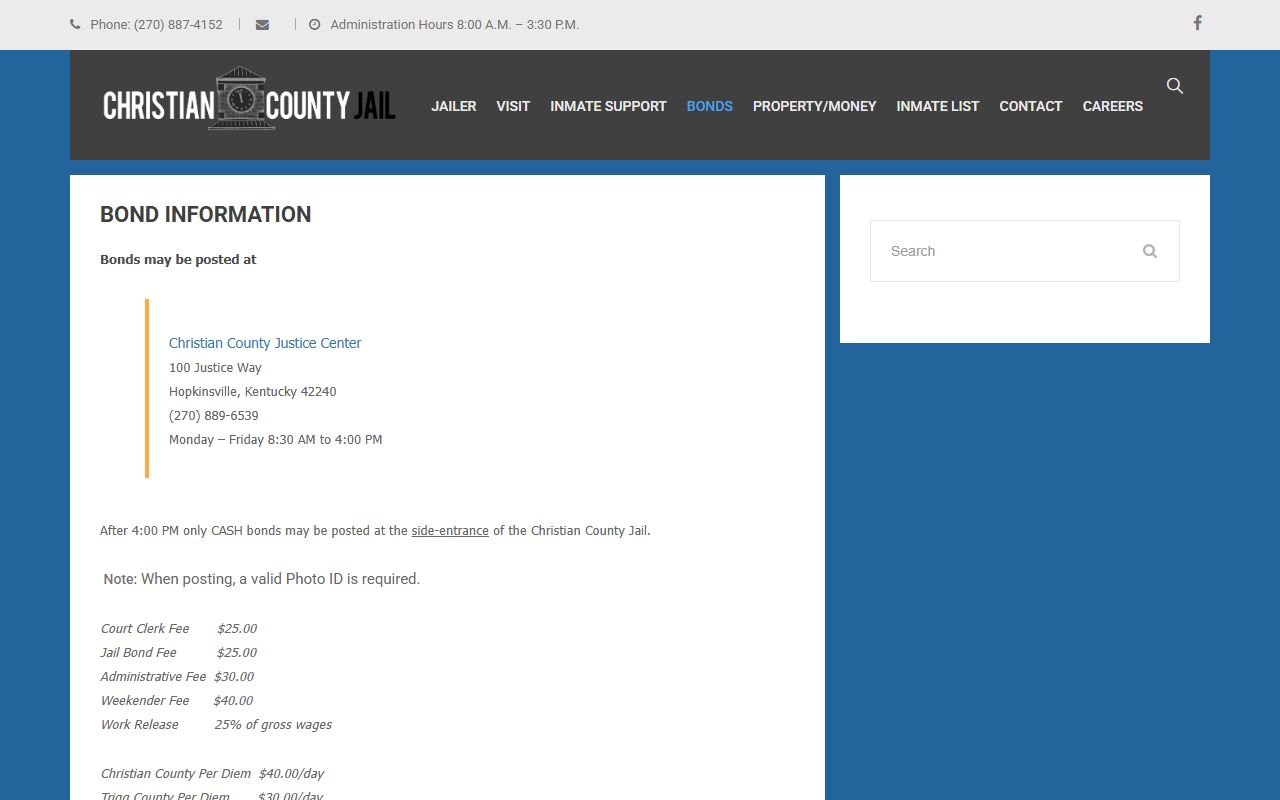
Bond data should be matched to the court case because payment, release, and later court compliance are separate events.
Prosecutors and Trigg County Charges
Kentucky does not use the term District Attorney for state court prosecutions. Lower-level local prosecution may involve the Trigg County Attorney, listed in county materials as Randy Braboy at 38 Main Street, A2, Cadiz, with phone 270-522-4733. Felony prosecution generally involves the Commonwealth's Attorney for the judicial circuit. Trigg County is in the 56th Judicial Circuit with Caldwell, Livingston, Lyon, and Trigg Counties.
The prosecutor decides what charge to file, amend, reduce, dismiss, or present to a grand jury, subject to the law and court rulings. Police and sheriffs make arrests and submit reports or citations, but a court charge is not always a simple copy of the arrest allegation. Victims, witnesses, and defendants should use the prosecuting office or court clerk for case-status routing, not the jail roster alone.
Charges Versus Convictions
A charge is an accusation. A conviction is a legal result after a guilty plea, verdict, or other finding of guilt. Trigg County arrest records may show why someone entered custody, and the court record may show what was charged, but neither proves conviction until the disposition shows that result.
| Point | Charge | Conviction |
|---|---|---|
| Stage | Filed early in the case. | Reached near the end of a count or case. |
| Meaning | Formal accusation by citation, complaint, information, or indictment. | Finding or plea of guilt on a charge. |
| Can change? | Yes, it can be amended, reduced, dismissed, or transferred. | May be appealed, vacated, or expunged only through legal process. |
| Where to verify | KYeCourts, docket entries, or Circuit Court Clerk. | Disposition, judgment, sentence, or certified court copy. |
Restricted Trigg County Charge Records
Kentucky public access is shaped by the Open Records Act, court rules, and case-specific limits. KRS 61.870 defines public-record terms, while the Chapter 61 Open Records index includes inspection rights and exemptions. Juvenile cases, mental-health matters, sealed records, expunged charges, protected personal identifiers, and active law-enforcement records may be withheld or redacted.
Kentucky expungement materials also matter. KCOJ expungement guidance explains the certification process, and KRS 431.073 covers certain felony conviction expungements. Dismissed or acquitted charges and misdemeanor or violation records have separate expungement paths. If an arrest or charge does not appear in public search results, the reason may be restriction rather than a data error.